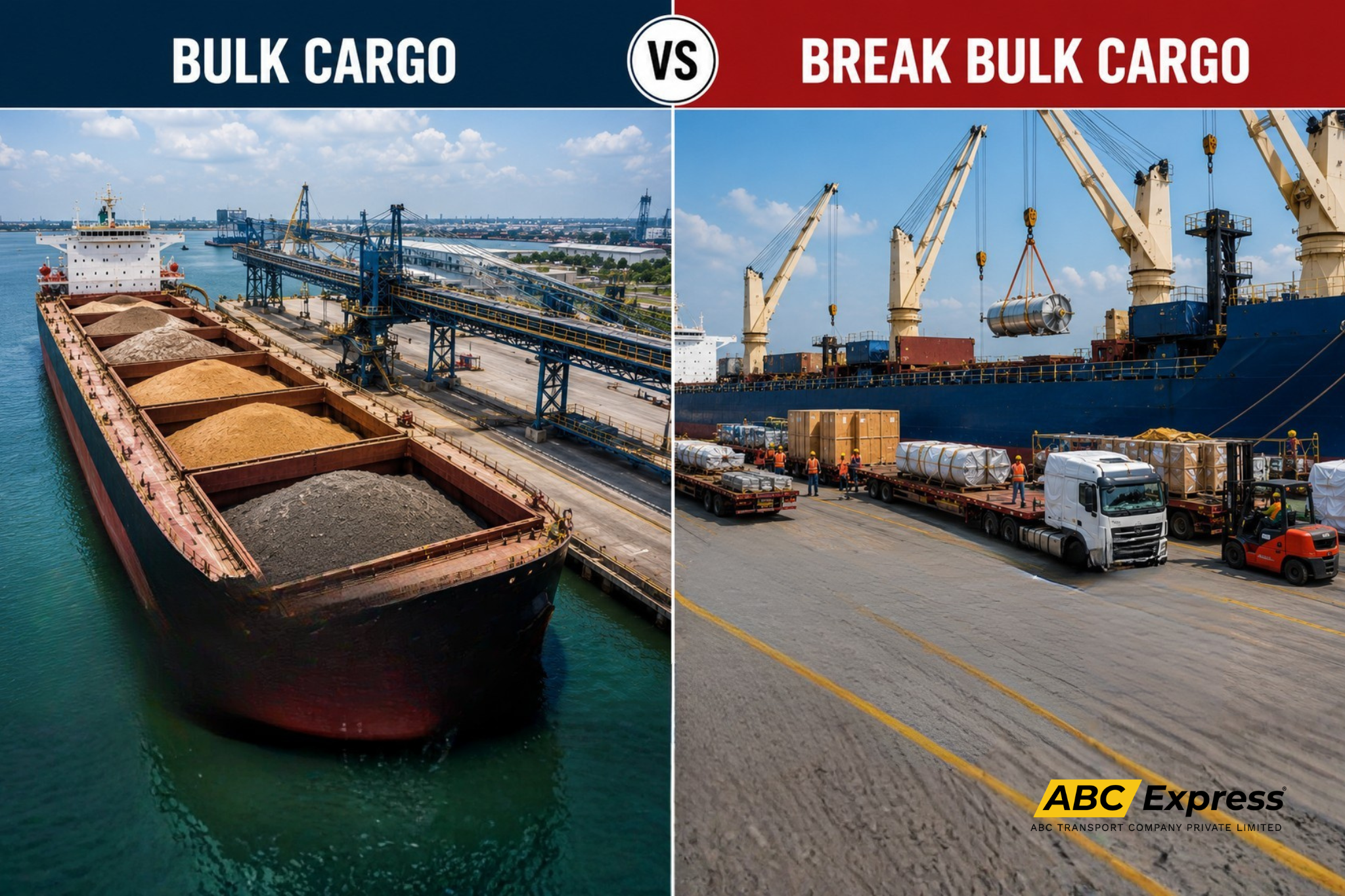
Shipping coal looks nothing like shipping construction equipment. Moving wheat works completely differently than transporting wind turbine blades. Loading crude oil has zero in common with handling steel beams.
These aren’t just different products. They’re entirely different cargo types requiring totally different ships, loading methods, and port facilities.
The shipping world divides cargo into two major categories: bulk and break bulk. Most people outside the industry have never heard these terms. But if you’re shipping anything internationally or across India, getting this wrong costs serious money, creates delays, and sometimes makes moving your product basically impossible.
Here’s what Bulk Cargo vs Break Bulk Cargo actually means and which one your business needs.
What Is Bulk Cargo?
Bulk cargo is loose stuff that gets poured, pumped, or dumped straight into a ship without any packaging. Cargo that flows like liquid or piles up like sand.
Think coal. Wheat. Rice. Crude oil. Chemicals. Iron ore. Cement. These materials get loaded in massive amounts – often thousands of tons at once – directly into specialized ships or bulk containers.
The key thing? No individual packages. Coal doesn’t arrive in boxes. Wheat doesn’t come in bags (not in bulk shipping anyway). The entire cargo is one big mass loaded and moved as a single unit.
Bulk cargo splits two ways:
Dry Bulk – Solid stuff like grains, coal, minerals, cement. Flows or piles but isn’t liquid. Ships called dry bulk carriers have huge cargo holds designed specifically for these materials.
Liquid Bulk – Liquids or gases like crude oil, chemicals, liquefied natural gas, vegetable oils. Gets pumped into and out of tanker ships with sealed tanks.
What Is Bulk Cargo Shipping optimized for? Moving enormous volumes as cheaply as possible per ton. When you’re shipping 50,000 tons of coal or 100,000 barrels of crude, the per-ton cost matters more than pretty much anything else. Bulk shipping achieves this through specialized ships, mechanical loading, and minimal human handling.
What Is Break Bulk Cargo?
Break bulk cargo is stuff that doesn’t fit in standard containers and can’t ship as bulk. Individual pieces or packages that get loaded onto ships separately – “break bulk” because the shipment breaks into separate units.
Steel beams. Construction equipment. Wind turbine parts. Large machinery. Vehicles. Boats. Industrial equipment. Project cargo for oil and gas operations. Oversized items that won’t squeeze into containers no matter how hard you try.
What is break bulk cargo handling like? Each piece gets loaded individually using cranes, forklifts, and other equipment. A shipment might be 50 steel beams, each 12 meters long, loaded one at a time. Or construction equipment too massive for containers, secured to the ship’s deck piece by piece.
Break Bulk Cargo Shipping takes more labor and specialized equipment compared to bulk or container shipping. But when your cargo is too big, too heavy, or shaped wrong for containers, it’s often the only option that actually works.
The cargo can be packaged (machinery in crates) or not (bare oversized equipment). What matters is each piece gets handled as a distinct item requiring individual loading, securing, unloading, and delivery.
Bulk Cargo vs Break Bulk Cargo: Side-by-Side Comparison
Here’s how these two cargo types differ across key factors:
| Factor | Bulk Cargo | Break Bulk Cargo |
| Cargo Form | Loose, homogeneous material with no packaging | Individual pieces or packages, each handled separately |
| Examples | Coal, grain, crude oil, iron ore, chemicals | Steel beams, machinery, wind turbines, vehicles, oversized equipment |
| Loading Method | Mechanical (conveyor belts, pumps, grab cranes) – fast and automated | Manual piece-by-piece using cranes – labor intensive |
| Ship Type | Specialized bulk carriers or tankers with open holds or tanks | General cargo ships or multipurpose vessels with cranes and deck space |
| Cost Per Ton | Lower – economies of scale work strongly | Higher – manual handling and time required |
| Loading Speed | Very fast – thousands of tons per day | Slower – individual pieces take time to load and secure |
| Packaging | None – cargo loaded loose | May be crated/packaged or bare depending on item |
| Port Requirements | Specialized bulk terminals (grain elevators, oil terminals, conveyors) | Heavy-lift cranes, deck space, skilled labor for securing |
| Measurement | Weight or volume (tons, cubic meters) | Counted as individual units |
| Securing Needs | Minimal – cargo sits in hold | Extensive – each piece individually lashed and secured |
The table makes it pretty clear these are fundamentally different shipping approaches, not just variations on the same thing.
Types of Bulk Cargo People Actually Ship
Bulk cargo dominates global shipping volumes. Main categories:
Farm Products – Wheat, corn, rice, soybeans moving in massive quantities between countries that grow stuff and countries that need to feed people. Sugar and coffee beans sometimes ship this way too.
Minerals and Ores – Iron ore, coal, bauxite, phosphates. Raw materials for factories worldwide travel as bulk cargo. One ship can carry enough iron ore to supply a steel mill for weeks.
Energy Products – Crude oil, refined petroleum, liquefied natural gas, coal. The entire global energy system depends on bulk cargo moving these products from where they’re produced to where they’re consumed.
Building Materials – Cement, sand, aggregates. Large construction projects import these as bulk when local supplies can’t keep up with demand.
Chemicals – Industrial chemicals, fertilizers, plastic pellets. Many ship as bulk in specialized tankers designed for hazardous materials.
The volumes are insane. Single bulk carriers transport 170,000 tons of iron ore or 300,000 barrels of crude oil in one trip. That’s why the per-ton cost can be so low – spreading ship costs across enormous quantities.
Types of Break Bulk Cargo You’ll See
Break bulk cargo covers a wide range but tends to fall into specific buckets:
Heavy Machinery – Construction equipment, mining machinery, factory equipment. Too big or heavy for containers but needs weather protection and careful handling so nothing breaks.
Project Cargo – Oil rig components, wind turbines, power plant parts. Often oversized pieces require serious planning and specialized shipping arrangements.
Vehicles and Boats – Cars, trucks, buses, small boats. Sometimes ships roll-on-roll-off but that’s related to break bulk methods.
Steel Products – Large structural beams, plates, coils. These exceed container dimensions and need flat stowage on deck or in holds where they can be secured properly.
Construction Materials – Prefab building components, bridge sections, industrial piping. Big infrastructure projects generate tons of break bulk cargo.
Military Equipment – Vehicles, aircraft, weapons systems. Government and military shipping involves break bulk methods because military equipment rarely fits in standard containers.
When You’d Pick Bulk Cargo Shipping
Bulk cargo makes sense when:
You’re shipping huge quantities of one thing. Thousands of tons of grain or hundreds of thousands of barrels where packaging each unit individually would be ridiculous.
Your stuff can be loaded mechanically without damage. Materials you can pour, pump, or dump without needing gentle handling.
Cost per ton is what keeps you up at night. Commodity materials with thin margins where bulk shipping’s lower per-ton cost makes or breaks profitability.
Origin and destination have bulk facilities. Major ports handling coal, grain, or oil have the infrastructure bulk cargo requires. Smaller ports often don’t.
Time isn’t critical for small amounts. Bulk carriers move large volumes, so accumulating enough cargo to fill a hold can take time.
When You Need Break Bulk Cargo Shipping
Break bulk becomes necessary when:
Your cargo laughs at standard container dimensions. Equipment that’s too long, wide, tall, or heavy for containers needs to break bulk.
Each piece requires individual handling. Construction equipment, large machinery, oversized components need careful loading and securing one by one.
Your cargo has odd shapes. Wind turbine blades, structural steel, and industrial equipment with irregular shapes don’t play nice with containerization.
You’re shipping project cargo. Multiple large pieces forming a complete installation – oil rig components, factory equipment, infrastructure projects – typically ship as break bulk.
Your destination lacks container facilities. Some ports have cranes and deck space for break bulk but can’t handle containers efficiently.
Break Bulk Cargo Shipping: What You’re Actually Dealing With
Shipping break bulk cargo involves considerations that don’t apply to bulk or container shipping:
Specialized Packing – Break bulk isn’t containerized, but often needs protective packing anyway. Crating, wrapping, preservative coatings for long ocean voyages. Prevents corrosion and damage from salt air and weather.
Cargo Securing – Every piece needs proper securing to prevent movement when the ship rolls. Chains, lashings, timber supports, sometimes welding to deck plates. This securing is critical for cargo safety and keeping the ship stable.
Documentation Gets Complex – Break bulk shipments involve more paperwork. Detailed cargo descriptions, weight and dimension specs, loading instructions, special handling requirements. Customs gets finicky about oversized items.
Insurance Considerations – Break bulk may require specialized marine insurance because of handling risks and exposed deck stowage. Standard cargo insurance might not cover certain break bulk scenarios.
Port Capabilities Matter – Not all ports handle break bulk efficiently. You need ports with heavy-lift cranes rated for your cargo weight, adequate laydown space, and stevedores who’ve done this before.
Planning Takes Time – Break bulk requires more advance planning than tossing stuff in containers. Coordinating cranes, figuring out securing, calculating load distribution for ship stability, arranging customs for oversized cargo.
The Future: Technology Changing How This Works
Both bulk cargo and break bulk cargo are evolving:
Automated Bulk Handling – Ports increasingly use robots and automated systems for bulk. Robotic grain elevators, automated conveyor systems, computerized tank gauging. Less labor, better efficiency, fewer mistakes.
Digital Paperwork – Blockchain and digital platforms streamline documentation for break bulk, reducing paperwork delays and improving tracking. What used to take stacks of paper now happens on apps.
Better Tracking – GPS and IoT sensors track break bulk cargo during transit. Shippers monitor location and conditions in real-time instead of wondering where their million-dollar equipment is.
Ship Design Innovation – Newer multipurpose vessels combine container, bulk, and break bulk capabilities. One ship can handle mixed cargo types, providing flexibility when markets shift.
Infrastructure Development – Developing countries are building bulk and break bulk facilities, creating new shipping routes and reducing reliance on traditional hub ports that charge premium rates.
These advances make both types of shipping more efficient, safer, and easier to coordinate across complicated global supply chains.
Wrapping This Up
Bulk Cargo vs Break Bulk Cargo isn’t just shipping jargon. These are fundamentally different approaches. Bulk handles loose, homogeneous materials in massive quantities using mechanized systems and specialized ships. Break bulk handles individual pieces too large or oddly shaped for containers, requiring manual handling and securing.
Understanding what is bulk cargo versus What Is Bulk Cargo helps businesses pick the right method. Break Bulk Cargo Shipping costs more per ton but becomes necessary for oversized or heavy items. Bulk shipping costs less per ton and works great for commodity materials – but only when you have the right cargo type and port facilities.
Most businesses use one type or the other based on what they ship. Commodity traders move bulk. Construction companies and equipment manufacturers typically need break bulk solutions.
Whichever applies to your business, understanding the differences, requirements, and practical considerations helps you ship more efficiently and avoid expensive mistakes from picking the wrong method for your cargo.