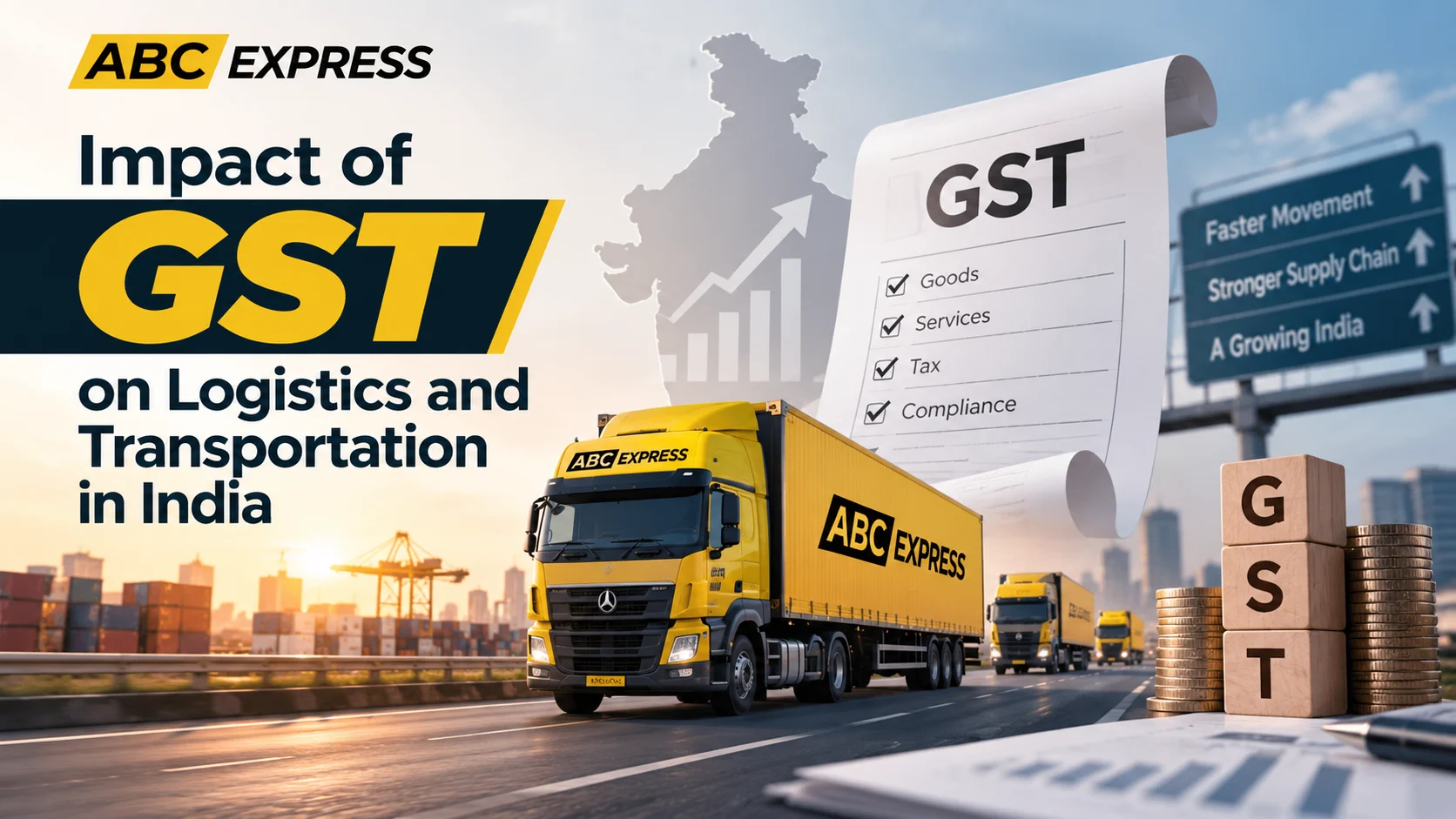
Before GST, moving goods across state borders in India meant navigating a patchwork of state-level taxes, entry permits, and checkpost delays. A truck crossing four states could lose a day or more to paperwork alone. The impact of GST on logistics, when it was introduced in July 2017, was therefore both immediate and structural — it changed how the industry operated at a fundamental level, not just how it calculated taxes.
ABC Express has operated freight transportation across India since 1958, with a fleet of 300+ vehicles and 80,000+ kilometres covered daily. The company has operated through both the pre-GST era and the decade since — making the transition firsthand. This guide covers what GST actually did to logistics in India, including the parts that improved and the complications that remain.
What Is the Impact of GST on Logistics?
The impact of GST on logistics is best understood in two distinct phases: the immediate transition effects (2017–2019) and the structural changes that followed once the system stabilised.
In the short term, the removal of multiple state-level taxes under a unified system reduced the document burden for cross-state freight significantly. Entry taxes, octroi, and state VAT on inter-state movement were replaced by a single Integrated GST (IGST) framework. For freight companies operating national networks, this was a genuine operational relief.
In the longer term, the impact of GST on logistics industry has been to incentivise the consolidation of warehousing — shifting from state-by-state depot models driven by tax avoidance to larger, strategically located distribution centres driven by pure logistics efficiency.
Positive Impact of GST on the Logistics Industry
Faster movement at state borders. The most immediate visible change was the elimination of state border checkposts for goods covered under GST. Transit times for inter-state shipments dropped significantly. What previously required 30–40% of transit time in state border delays became a non-issue for GST-compliant consignments.
Unified tax structure. GST on transport services replaced multiple overlapping taxes — service tax, state taxes, and various cess charges — with a streamlined framework. For freight companies and their clients, invoicing and input tax credit claims became significantly simpler.
Input Tax Credit (ITC) availability. Under GST, businesses can claim input tax credit on GST paid on logistics services — GST on freight charges paid to transporters can be set off against output tax liability. This effectively reduces the net cost of logistics services for GST-registered businesses and makes freight a less opaque cost in the supply chain.
Warehousing rationalisation. Pre-GST, companies maintained warehouses in multiple states to avoid interstate tax implications. The GST impact on logistics industry includes the consolidation of this fragmented warehouse network into larger, fewer, more efficient distribution hubs. This has reduced inventory carrying costs and improved order fulfilment cycles for major retail and manufacturing clients.
E-way bill system. The electronic e-way bill for goods in transit replaced multiple physical documents with a single digital permit. For logistics operators, this reduced the paperwork burden at vehicle level and enabled better fleet utilisation — trucks spend more time moving and less time waiting.
Read more: Fruit Transport in India: Best Practices for Safe and Timely Delivery
Negative Impact of GST on the Logistics Industry
The impact of GST on logistics hasn’t been uniformly positive, particularly for specific segments of the industry.
Small transporters bear the compliance burden. GST compliance requires regular filings, digital record-keeping, and knowledge of ITC processes. Small operators — which form a large portion of India’s truck fleet — often lack the infrastructure to manage this. Many shifted to working under the Goods Transport Agency (GTA) model where the responsibility shifts to the recipient, but the compliance complexity didn’t disappear.
GST on freight charges for GTA services. Under the reverse charge mechanism, GST on freight charges paid to a Goods Transport Agency is typically paid by the recipient (company receiving the service) rather than the GTA itself. While this protects smaller transporters from direct GST liability, it creates complexity in the buyer-seller-transporter relationship, particularly for small businesses unfamiliar with reverse charge accounting.
Transitional inventory losses. During the GST transition, companies with significant stock held at state depots couldn’t always claim full input credit on pre-GST tax paid on that inventory. This created a transitional loss that affected cash flow for some logistics operators and their clients.
Fuel outside GST. Diesel — the primary fuel for the freight industry — remains outside the GST framework. This means GST impact on transportation industry is partial: logistics companies can’t claim input tax credit on diesel costs, which constitute 30–35% of total operating costs. This is a longstanding structural issue that limits the full benefit of GST for the transport sector.
Impact of GST on Transportation Services
GST on transport services is currently structured as follows:
- GTA services (road freight): 5% GST under forward charge (no ITC for GTA) or 12% with ITC available
- Air freight: 18% GST
- Rail transport: Exempt from GST for most categories of goods
- Courier services: 18% GST
For road freight — which moves the majority of goods in India — the 5% rate under the reverse charge model is the most common. This means recipients of GTA services (the businesses sending goods) typically account for the GST rather than the transporter.
The GST impact on transportation industry for inter-city and long-haul road freight has been broadly positive in operational terms, even while compliance complexity remains a challenge for smaller operators.
Impact of GST on Warehousing and Supply Chains
The warehousing consolidation under GST is one of the most significant structural shifts in Indian logistics over the past decade.
Pre-GST, companies maintained warehouses in every state where they had meaningful sales volume, because moving goods into a state without a depot created interstate tax complications. The result was fragmented inventory spread across multiple small warehouses, higher stock holding costs, and inefficient distribution.
Warehousing consolidation GST has enabled companies to redesign their supply chains around logistics efficiency rather than tax efficiency. Regional distribution centres — located near major road and rail corridors — now serve multiple states from a single facility. This has reduced inventory carrying costs and improved service levels for end customers.
The GST logistics sector India impact on warehousing has also spurred significant investment in large-format Grade A warehousing across industrial hubs — driven by e-commerce, FMCG, and industrial goods sectors.
How Has GST Changed the Logistics Sector in India?
The impact of GST on logistics in India is now measurable across several dimensions:
Transit time reduction: Average transit time for inter-state shipments fell by an estimated 20–30% in the first two years post-GST, primarily due to border checkpost elimination.
Industry formalisation: GST compliance requirements accelerated the shift from unorganised to organised logistics. Businesses increasingly prefer freight partners who can provide GST-compliant invoices and e-way bill documentation.
Technology adoption: The e-way bill system drove technology adoption across the supply chain — trucking companies, warehouses, and shippers all needed digital systems to generate, validate, and track e-way bills.
Cost structure shifts: While direct tax costs reduced for compliant operators, the fuel exclusion from GST remains a structural disadvantage that limits the full impact of GST on logistics industry cost reduction.
Conclusion
The impact of GST on logistics has been transformative in the decade since its implementation — removing the biggest operational friction (state border delays), simplifying the tax structure, and driving warehouse rationalisation that has made Indian supply chains more efficient. The GST logistics sector India impact is still unfolding as compliance norms tighten and the industry continues to consolidate.
For freight transportation clients, working with GST-compliant operators who maintain proper documentation, e-way bill discipline, and transparent invoicing is essential for claiming ITC benefits and avoiding compliance risk.
Visit abctransport.co.in or call 7065001053 for freight enquiries across India.
FAQs
- What is the impact of GST on logistics?
GST simplified interstate movement, reduced border delays, streamlined taxation, and encouraged warehouse consolidation across India. - How does GST apply to freight charges?
GST on freight charges depends on the transportation service and applicable tax mechanism, including forward or reverse charge for GTA services. - What is the GST on transport services in India?
GTA road freight can attract 5% or 12% GST depending on the applicable scheme, while other transport modes have different rates. - How has GST affected the logistics industry?
GST has reduced transit delays, encouraged technology adoption, supported industry formalisation, and improved supply chain efficiency. - What is warehousing consolidation under GST?
GST encouraged businesses to replace multiple state-level warehouses with larger regional distribution centres based on logistics efficiency rather than tax considerations.