Most damage doesn’t happen on the road. It happens at the handling points — when your carton gets lifted, stacked, moved at a transshipment hub, and co-loaded with goods from four other shippers in a shared truck space. The road is the easy part. The handling is where poorly packed goods get compromised.
Part load transportation works because multiple shippers share a single truck, splitting the cost of space. The trade-off is that your goods move through more hands than they would in a dedicated full truck load. A shipment that travels direct from Delhi to Mumbai on FTL gets loaded once and unloaded once. The same shipment moving by PTL may be handled 3–4 times at intermediate facilities. Every extra handling event is a risk point — and packing and labelling directly control how that risk plays out.
ABC Express has operated goods transport services across India since 1958, with 300+ trucks and ISO 9001:2015 certified operations. This guide covers what the team sees go wrong in part load transportation and the practical steps that prevent it.
Why Proper Packing and Labelling Matter
In shared truck space, your goods aren’t the only consideration. Handlers don’t know the contents of each box — they’re moving volume efficiently. Packing that works in isolation may fail when a 20-kg carton is stacked on top or when another shipper’s goods shift during transit.
Labelling matters for a different reason: it’s how the goods find their way through multiple handling points and reach the right consignee at the destination. A label that falls off, fades, or was never legible to begin with creates misdeliveries and delays that are almost always attributed to the carrier — but caused by the shipper.
How to Pack Goods for Part Load Shipments
Choose the right carton strength. Carton strength — measured as bursting strength (BS) or edge crush test (ECT) rating — determines how much stacking weight a box can handle. For part load transportation, a minimum 5-ply carton is recommended for most goods. Single-ply and 3-ply cartons are inadequate for commercial goods transport where stacking is routine.
Fill voids inside the carton. Air gaps inside a carton allow contents to shift during transit. Use bubble wrap, foam, paper, or air pillows to fill empty space. Contents that move inside the carton absorb impact differently than snugly packed contents — and damage inside an intact carton looks like mishandling when it’s actually inadequate internal packing.
Palletisation where volume justifies it. Palletisation — strapping goods to a pallet and stretch wrapping the assembly — is the most effective way to protect larger consignments in part load transportation. A stretch wrapped pallet is easier to move without touching individual cartons and keeps multi-carton consignments together through transshipment.
Stretch wrapping for stacked cartons. For 4 or more cartons, stretch wrapping the assembly prevents separation during transit. Cartons that separate at a hub often arrive late or get misassigned.
Extra protection for fragile goods. Fragile goods require internal cushioning, double-boxing where appropriate, and fragile goods marking on the external carton. Double-boxing means placing the product in its own internal box and then packing that inside a stronger outer carton with padding between the two. The external carton should show no indication of the contents from surface contact.
Protect corners and edges. Corners are the first points of impact in any drop or bump. Cardboard corner guards or foam corner pieces on the outside of the carton significantly reduce corner damage.
How to Label Part Load Shipments Correctly
Shipping labels must be clear and durable. Use printed labels, not handwritten ones. The label should include the consignee name, full delivery address, pin code, contact number, and the goods transport services booking reference. Thermal or laser-printed labels are more durable than inkjet in transport environments.
Placement matters. Apply the primary label on the top surface of the carton. Apply a duplicate label on one of the side faces. At handling points, handlers scan from the side — a label only on the top gets missed when cartons are stacked.
Laminate or cover with clear tape. Moisture, friction, and handling cause labels to fade or peel. Covering the label with clear tape adds durability without obscuring the print.
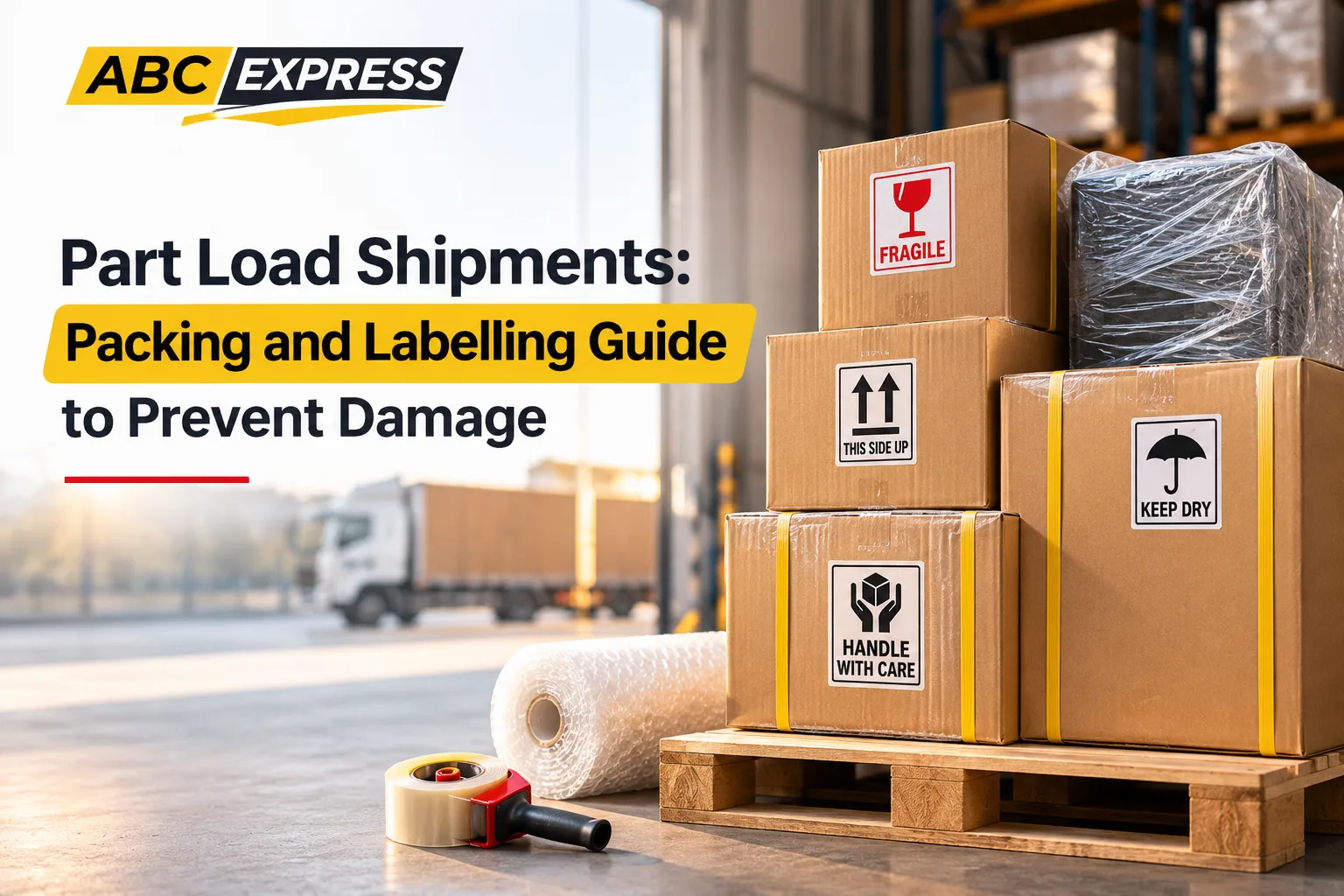
Fragile goods marking. For delicate items, mark “FRAGILE,” “HANDLE WITH CARE,” and “THIS SIDE UP” clearly on all four sides of the carton. Fragile goods marking at part load transportation facilities is a handler cue — it doesn’t guarantee careful handling, but it reduces the probability of stacking and impacts for marked cartons.
Don’t obscure the label with tape or packing material. This sounds obvious but is a common mistake — label covered by stretch wrap or sealed under tape that handlers can’t read without damaging the carton.
Documents and Insurance for Part Load Shipments
Consignment note. The consignment note is the primary document for any part load transportation booking — it specifies sender, consignee, goods description, weight, declared value, and booking reference. Keep a copy; the original travels with the goods. Discrepancies create problems at delivery and complicate damage claims.
E-way bill. For interstate shipments above ₹50,000 in value, an e-way bill is required. Confirm who generates it before the truck leaves.
Goods-in-transit insurance. PTL bookings typically include basic carrier liability, which is limited. Purchase goods-in-transit insurance separately for high-value goods. A damage claim without it often settles at a fraction of the actual value.
Common Packing and Labelling Mistakes to Avoid
Using second-hand cartons. Used cartons have reduced structural integrity — the corrugated flutes compress over multiple uses. New cartons for every shipment.
Under-declaring value to reduce insurance cost. A damage claim settles on declared value. Under-declaration saves a small amount upfront and creates a large shortfall when a claim is needed.
Single label only. If the primary label comes off at a transshipment hub, the consignment is unidentified. Always apply a duplicate label on a side face.
Loose items without internal packaging. Items placed loose in a carton without internal packing absorb every impact directly. Internal cushioning is not optional for anything fragile or of significant value.
Packing beyond carton strength. Overfilling a carton beyond its rated weight causes the base to give way under stacking. Fill to rated capacity.
How to Choose Reliable Part Truck Load Services
The packing practices above reduce the shipper’s risk. When evaluating part truck load services, look for:
- GPS tracking on PTL movements — so you know where the consignment is through every intermediate point.
- Clear transshipment hub process — know which facilities the goods will pass through and what the handling protocols are.
- Digital proof of delivery — confirmation of delivery with timestamp and recipient signature within 24 hours.
- Transparent damage claim process — stated timelines and documentation requirements in writing before you book.
ABC Express provides part load transportation with digital tracking, structured handling at all transshipment points, and account management for regular shippers. For PTL bookings and rate enquiries, contact info@abctransport.co.in or call 7065001053.
Conclusion
Part load transportation damage is preventable in most cases. The right carton, internal packing, clear labelling, and proper documentation reduce the risk at every handling point. Combined with a reliable carrier that operates structured transshipment facilities, goods arrive in the condition they were packed in.
The shipper controls the packing. Choose the carrier the same way you choose the packing — deliberately, before the goods are loaded.
FAQs
How should I pack goods for part load transportation?
Use strong cartons, fill internal gaps with cushioning, protect corners, and stretch-wrap multiple cartons or palletised goods to prevent movement and damage.
What is the best way to label part load shipments?
Use durable printed labels with the consignee’s name, complete address, PIN code, contact number, and booking reference. Place duplicate labels on the top and side.
Is insurance necessary for part truck load services?
Insurance is recommended for high-value goods because basic carrier liability may not cover the full value of damaged or lost shipments.
What documents are required for part load transportation in India?
Keep the consignment note, accurate goods description, declared value, and applicable e-way bill ready before dispatch. Confirm documentation requirements with your transport provider.
How do I choose reliable goods transport services for part load shipments?
Look for GPS tracking, clear transshipment procedures, digital proof of delivery, transparent damage claim policies, and experience handling shared-load consignments.