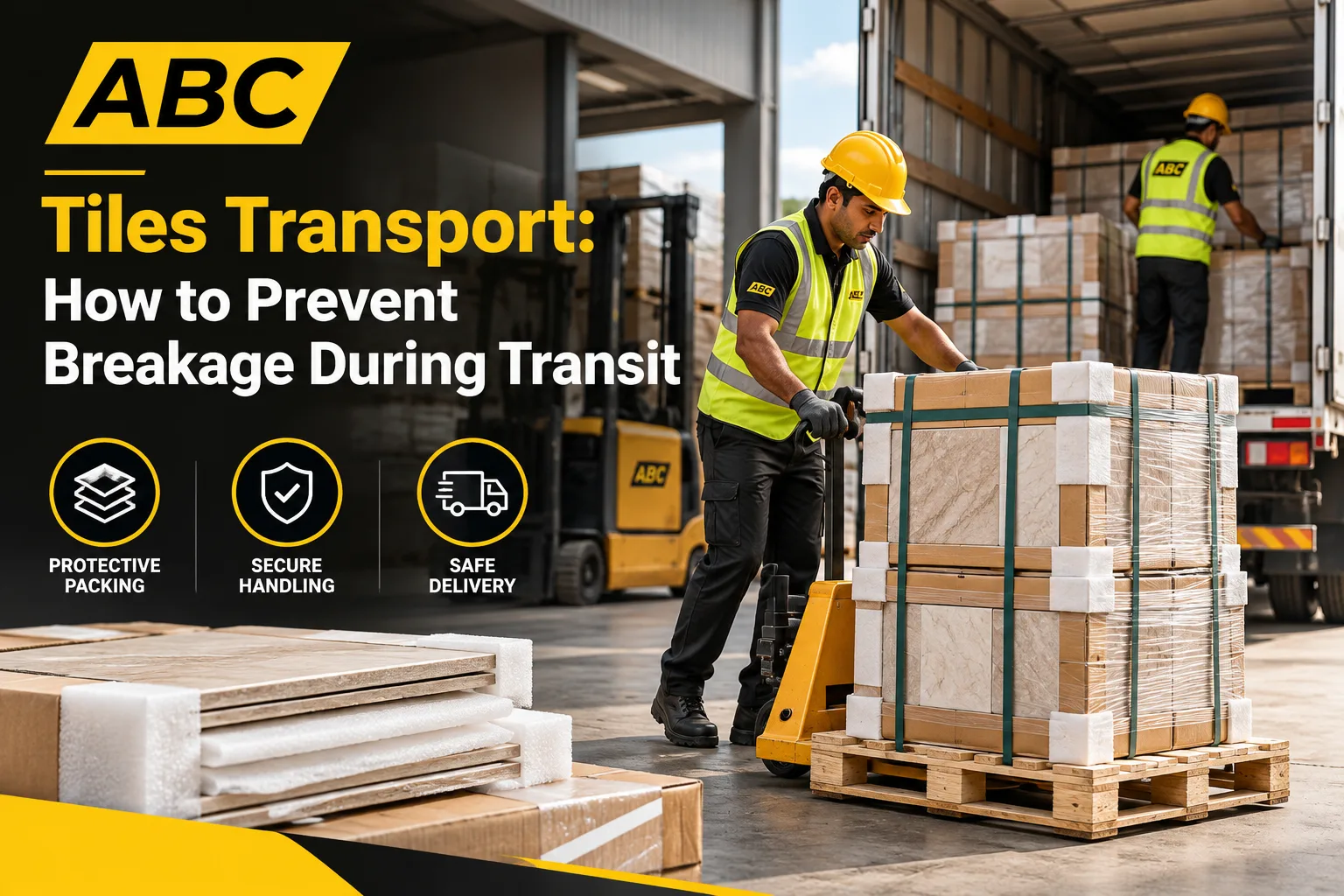
Tiles transport is, in itself, a deceptively heavy shipment. Ceramic and vitrified tiles are fragile, heavy, high-value, and arrive at building sites in fairly fragile condition, A consignment that leaves the factory intact and arrives with 15% breakage has already generated a loss that usually exceeds what was saved by choosing the cheapest carrier.
Traffic and infrastructure is an issue for many shipments, but the fundamental issues with tile shipped is packing and handling. Get these perfect, and tiles can be shipped thousands of kilometers without major loss. Get any one of these three wrong, and you’ll be facing broken corners and chiselled edges before the tiles ever arrive. ABC Express shippers building materials across India through FTL, PTL, and Parchun transportation from the region, ceramic and vitrified tile freight are among the types of shipments where shippers’ preparation and carrier handling protocols make all the difference. Here’s what shipper preparation looks like.
How to Pack Tiles for Transport
Tiles packaging methods are the first line of defence against transit breakage. Most tile manufacturers already ship in factory cartons — the question is how those cartons should be prepared and consolidated for transport.
Individual tile protection — factory-standard cartons interleave tiles with foam or corrugated sheet separators. If tiles are being repacked or if the original carton is damaged, each tile should have a separator between it and the adjacent tile. Tile-on-tile contact without cushioning is where edge chips originate.
Carton integrity — reject damaged cartons before loading. A compromised corner or wet base means the carton has lost most of its protective function. Reinforce or replace before loading.
Palletising — for full-truck tile shipments, palletising cartons is significantly better than floor stacking. Pallets allow forklift handling, stretch film wrapping as a single unit, and better moisture protection. Tiles packing for transport on pallets dramatically reduces hand-stacking events.
Stretch wrap — wrap pallets tightly, from base to top. This binds the carton stack into a single rigid unit that resists the lateral movement that causes tiles to shift within cartons on the road.
How to Load Tiles in a Truck Safely
How to load tiles in a truck properly is a question most shipping teams underestimate — and the loading configuration determines how the entire shipment behaves on the road.
Floor boarding — tiles should not be loaded directly on a metal truck floor. Even with pallets, place plywood sheets under the pallets to distribute weight and protect carton bases from condensation and any residual moisture on the vehicle floor.
Stack height — never stack tile cartons beyond five high without pallet and stretch wrap restraint. Lower, wider configurations are more stable on corners and under braking.
Weight distribution — load tiles toward the front, centred over the vehicle’s wheelbase. Back-heavy or asymmetric loads increase pitch and lateral stress respectively.
Restraint — strap across the load at multiple heights. Tiles shift more than most cargo types because of smooth carton contact surfaces. Strapping holds the load as a unit through the vehicle’s movement.
Last in, first off — sequence loads so the first delivery point is accessible from the rear without disturbing other cartons. Rearranging mid-route causes breakage.
Common Causes of Tile Breakage in Transit
Understanding what causes tiles breakage in transit allows both shippers and carriers to target the right interventions.
Carton-to-carton impact during braking — tiles on loose unsecured stacks shift forward under braking. The impact as they arrest against adjacent stacks breaks tiles at the edges and corners. Cargo strapping is the fix.
Corner compression — the corners of tile cartons are the weakest points. Placing heavy cargo adjacent to tile cartons, or stacking other goods on top, concentrates load at exactly these weak points. Tiles should be loaded with only tiles adjacent wherever possible.
Floor moisture — wet truck floors weaken carton bases over a long transit. A damaged carton base means the lower tiles in the stack are supported by other tiles rather than the carton structure — which creates point loads that cause breakage.
Loading impact — dropping, tipping, or dragging cartons breaks tiles before the truck moves. Handling protocols matter as much as road conditions.
Vibration on rough roads — prolonged vibration works tile edges against each other through carton walls when separators are absent. Long routes through poor road infrastructure should be anticipated in packaging design.
Ceramic vs Vitrified Tiles: Transport Considerations
Ceramic tiles transport and vitrified tiles transport have different risk profiles.
Ceramic tiles — larger grain structure, more porous, and generally more brittle than vitrified. They’re typically heavier per unit area for equivalent thickness and more susceptible to moisture damage. Ceramic tile shipments need better moisture protection and more conservative stack heights.
Vitrified tiles — denser, harder, and more uniform in composition. They’re more resistant to chipping and edge damage than ceramic under equivalent impact, but the higher density means heavier cartons that create more load concentration when stacked. Vitrified tile pallets should be weight-checked against the vehicle’s rated floor load.
Large format tiles (800mm+) — always palletise, never hand-stack multiple high, and keep upright where possible. Horizontal stacking concentrates stress across the full face.
How to Choose the Right Tiles Transport Service
A service that reduces breakage operates differently from a general freight carrier.
Ask about load restraint equipment. Does the carrier use cargo strapping as standard, or only when requested? Strapping should be standard on fragile cargo.
Confirm their experience with building materials freight. Carriers who regularly move tiles, glass, and ceramics develop handling protocols appropriate to fragile goods. General cargo carriers may not.
Check vehicle conditions. Dry, weatherproof vehicles with clean floors and functioning strapping points are the baseline. Request these specifically rather than assuming them.
Understand multi-drop sequencing. For deliveries to multiple points, confirm the carrier plans the load sequence — not just the route — before loading begins.
Document at loading. Photograph carton condition and pallet state at handover — essential if breakage claims arise at delivery.
Tiles Transport Charges: What Affects the Cost?
Tiles transport charges are determined by several variables beyond distance.
Weight and volume — tiles are dense, so weight usually governs over dimensional volume. Heavier per-pallet loads attract higher per-tonne freight costs but the per-tile transport cost decreases with better load efficiency.
Route and distance — base freight rates increase with distance. Longer routes through difficult terrain (hill sections, poor-quality roads) also carry risk premiums from some carriers.
Vehicle type — FTL for a full truck load of tiles is more cost-efficient per unit than PTL consolidation. If volume supports FTL, it’s typically the better choice for both cost and breakage risk.
Packaging quality — well-palletised, stretch-wrapped shipments may avoid fragile-goods surcharges that apply to loose-carton loads.
Conclusion: Tips for Safe Tiles Transportation
Tile transit losses are preventable. The checklist that matters:
- Verify carton integrity before loading — reject damaged packaging
- Palletise and stretch-wrap wherever volume supports it
- Use floor protection in the vehicle
- Strap loads at multiple heights
- Sequence multi-drop loads at loading, not mid-route
- Photograph the load at both ends
For tile freight across India — FTL, PTL, and partial loads — ABC Express provides building materials transport with a 300+ vehicle fleet, real-time tracking, and digital POD across all 36 states. Visit abctransport.co.in to enquire.
FAQs
- How do you transport tiles without breakage?
Use sturdy cartons, protective separators, palletising, stretch wrapping, and proper load restraints to minimise tile damage during transit.
- How should tiles be packed for transport?
Pack tiles in intact cartons with cushioning between them, then palletise and stretch-wrap the cartons to prevent shifting.
- How do you load tiles safely in a truck?
Use floor protection, distribute weight evenly, avoid excessive stacking, and secure the load with straps to prevent movement during transit.
- What is the difference between ceramic and vitrified tiles transport?
Ceramic tiles need careful moisture protection, while denser vitrified tiles require attention to carton weight and vehicle floor-load limits.
- What factors affect tiles transport charges?
Tiles transport charges depend on shipment weight and volume, distance, vehicle type, packaging quality, and whether you choose FTL or PTL services.