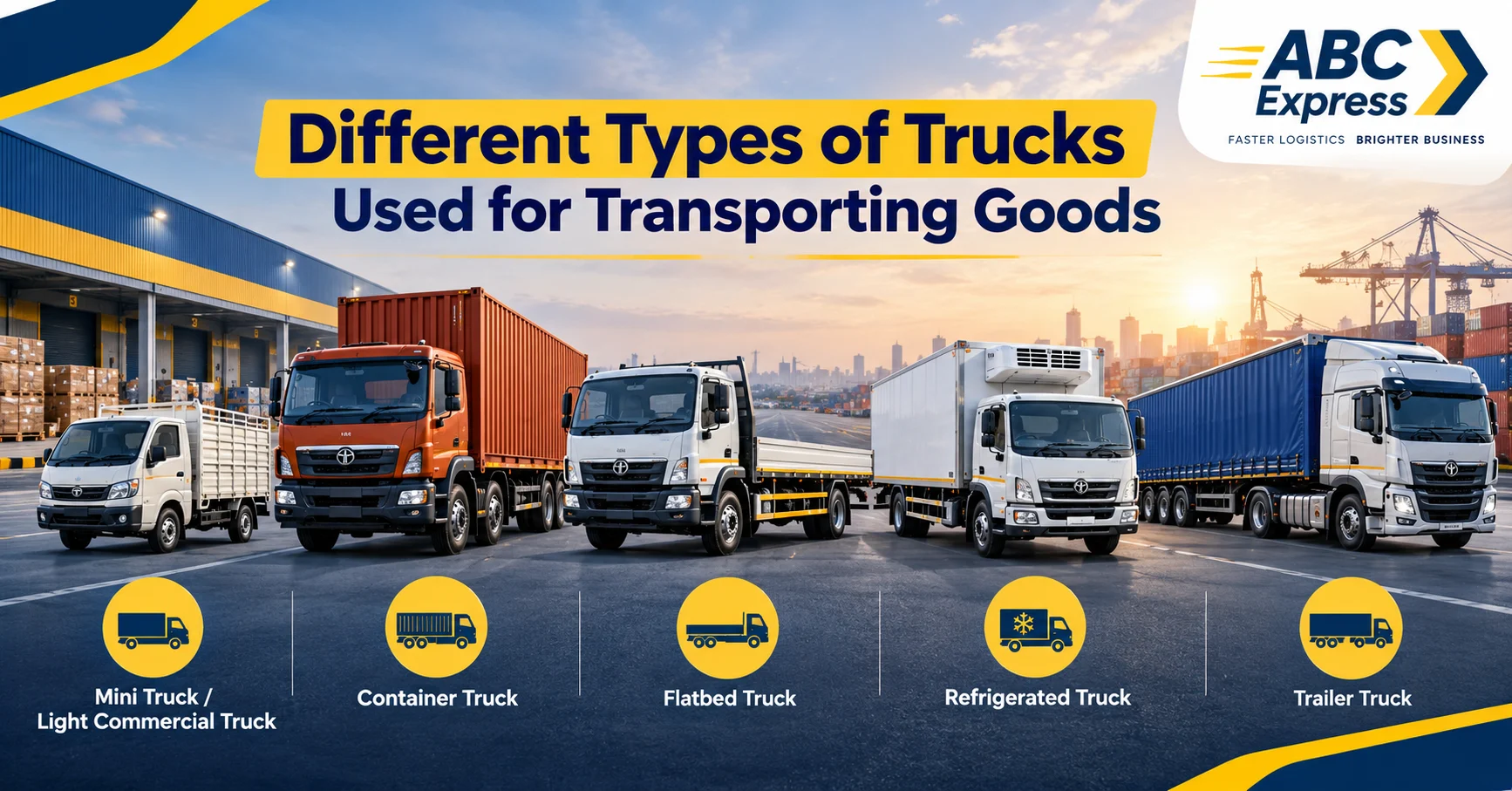
Not all goods move the same way. A shipment of automotive parts from Pune to Delhi has different requirements from a cold-storage consignment of mangoes from Nashik to Hyderabad, or a bulk cement load from a plant in Rajasthan to a construction site in Uttar Pradesh. Understanding the types of trucks used in goods transport is the practical foundation for making better freight decisions — because the wrong vehicle type adds cost, risk, and delay that the right one avoids entirely.
ABC Express has operated freight services across India since 1958, with a fleet covering FTL, PTL, and Parchun consignments across all 36 Indian states. Their operational depth across truck types and load categories is what allows them to match vehicle to cargo reliably. This guide covers the main types of trucks for transportation across Indian logistics, what each one is suited for, and how to choose correctly for your freight requirements.
How Are Trucks Classified for Goods Transport?
Truck classification for logistics in India uses a few overlapping systems.
By payload capacity:
- Light commercial vehicles (LCV) — up to 7.5 tonnes GVW
- Medium commercial vehicles (MCV) — 7.5 to 12 tonnes GVW
- Heavy commercial vehicles (HCV) — above 12 tonnes GVW
- Multi-axle vehicles — above 25 tonnes GVW
By body type:
- Open flatbed
- Closed container (fully enclosed)
- Side-open / side-curtain
- Refrigerated (reefer)
- Tipper / dumper
- Tanker
By application:
- General dry goods
- Perishables and cold chain
- Bulk commodities
- Liquid and gas
- Over-dimensional cargo (ODC)
Most freight decisions start with payload requirement, then filter by body type based on what the cargo needs — weather protection, temperature control, ease of loading.
Read more: Top Challenges in the Indian Logistics Industry Businesses Must Know
Different Types of Trucks Used in Logistics
Mini Truck (Tata Ace, Mahindra Jeeto — 0.5 to 1 tonne)
The smallest commercial vehicle category in Indian logistics. Used for intra-city last-mile delivery, small-batch retail distribution, and e-commerce fulfilment. Not suited for interstate movement or bulk loads but critical for the final delivery leg in urban areas.
Small Truck / Pickup (1 to 2.5 tonnes)
Larger than mini trucks, used for intra-city and short-haul distribution. Common in vegetable and fruit distribution from wholesale markets to retailers, and for light manufacturing supply within cities. The truck types used in goods transport at this scale are often the workhorses of local trade.
Medium Truck (2.5 to 7.5 tonnes)
The backbone of regional distribution in India. Used for FMCG, packaged goods, building materials, and manufacturing components on routes of 200–500 km. Economical to operate, accessible to most loading docks, and available in both open and closed body configurations.
Full-Size Truck / Single Axle HCV (10 to 16 tonnes)
One of the most common types of trucks in goods transport for national logistics. These handle FTL movement of industrial goods, construction materials, and packaged consumer goods across interstate routes. Closed container variants are used for high-value or weather-sensitive cargo.
Multi-Axle Vehicle / 32-Wheeler (25 to 40 tonnes)
Used for large FTL loads — heavy machinery, bulk industrial materials, project cargo. Multi-axle trucks are the most cost-efficient per tonne for very large loads on major corridors, but they’re restricted on certain roads and bridge load limits.
Refrigerated Truck (Reefer)
Temperature-controlled heavy vehicles for goods transport involving perishables — fresh produce, dairy, pharmaceuticals, processed food. The reefer maintains a preset temperature range throughout transit. Essential for cold chain logistics where product integrity depends on temperature continuity.
Flatbed / Open Truck
Open cargo area without walls or roof. Used for construction materials, machinery, steel, and over-dimensional cargo that can’t fit in an enclosed container. Loads are secured with ropes, chains, or straps. The most flexible body type for irregular or oversized cargo dimensions.
Container Truck (20ft / 32ft / 40ft Containers)
Closed metal containers mounted on a trailer chassis. Standard in port-related freight and for high-value or weather-sensitive goods requiring full enclosure. The container acts as both the vehicle body and the delivery unit — at the destination, the container itself can be detached and stored.
Tanker Truck
Designed for liquid and gas transport — petroleum products, chemicals, food-grade liquids, LPG. The cylindrical tank is the body. Not interchangeable with dry goods transport and subject to specific regulatory requirements for hazardous materials.
Which Truck Type Is Used for Different Goods?
| Goods Category | Typical Truck Type |
| FMCG / packaged goods | Medium truck, closed container HCV |
| Agricultural produce | Reefer (perishables), open medium truck (bulk) |
| Construction materials | Flatbed HCV, tipper, multi-axle |
| Industrial machinery | Flatbed, multi-axle ODC trailer |
| Pharmaceuticals | Reefer, closed container |
| E-commerce | Mini truck, pickup (last mile), FTL HCV (line haul) |
| Petroleum / chemicals | Tanker truck |
| Textiles / garments | Closed container HCV |
Truck Sizes and Load Capacity in India
| Truck Type | Approximate Payload | Common Route |
| Mini truck | 500 kg – 1 tonne | Intra-city |
| Small truck | 1 – 2.5 tonnes | Intra-city, short-haul |
| Medium truck | 2.5 – 7 tonnes | Regional (100–500 km) |
| Single-axle HCV | 10 – 16 tonnes | National (500–2000 km) |
| Multi-axle | 20 – 40 tonnes | National, heavy cargo |
| Reefer | 5 – 20 tonnes | Any distance, cold chain |
| Container | 18 – 28 tonnes | National, port-linked |
How to Choose the Right Truck for Goods Transport
Match the vehicle to the cargo volume, not the other way. A consignment that fills 40% of a large truck’s capacity is paying for unused space. Matching load size to vehicle capacity — FTL for full loads, PTL consolidation for partial loads — is the most direct cost lever.
Consider cargo characteristics first. Does the cargo need temperature control? Weather protection? Is it over-dimensional? Can it be stacked? The body type requirement often narrows the choice before payload even becomes a factor.
Factor in the route. Multi-axle vehicles are restricted on certain roads. Reefer trucks need cold-chain infrastructure at both ends. Mini trucks aren’t suited for highway interstate movement. Route constraints eliminate options that appear suitable on paper.
Different types of trucks in India have different regulatory requirements. Oversized cargo needs special permits. Hazardous materials require ADR compliance. Interstate movement requires e-way bills. Understanding which regulatory layer applies to your cargo type is part of the freight planning process.
Why Choosing the Right Truck Matters
Using the wrong truck type in goods transport creates specific problems:
Oversized vehicle for small load — high per-unit freight cost, difficult to justify for low-margin goods.
Undersized vehicle for actual load — overloading creates weighbridge penalties, legal liability, and higher accident risk.
Open truck for weather-sensitive cargo — moisture and dust damage in transit that a closed container would have prevented.
Standard truck for cold chain cargo — temperature excursions that render pharmaceutical or food cargo unsaleable.
The types of trucks used in goods transport determine not just the cost of the shipment but whether the cargo arrives in usable condition. Getting this match right is the first decision in any freight planning exercise.
Conclusion
The right truck type is determined by the cargo’s volume, weight, fragility, temperature requirements, and the route it needs to travel. Understanding different types of trucks in India — and what each one is genuinely suited for — is what converts freight spend from a fixed cost into a manageable variable.
ABC Express operates a full range of commercial vehicles for goods transport across India — FTL, PTL, and Parchun services with real-time tracking and a 300+ vehicle fleet. Visit abctransport.co.in to enquire about the right vehicle for your consignment.
FAQs
- What are the different types of trucks used in goods transport?
Common types include mini trucks, medium trucks, HCVs, multi-axle vehicles, reefers, flatbeds, container trucks, and tankers. - How do I choose the right truck for goods transportation?
Consider the cargo’s weight, volume, temperature requirements, fragility, loading needs, and the route before selecting a truck. - What type of truck is used for interstate transport?
Full-size HCVs, multi-axle vehicles, and container trucks are commonly used for long-distance and interstate goods transportation. - What is the difference between a mini truck and a full truck?
Mini trucks handle small loads and local deliveries, while full-size trucks carry larger loads over regional and interstate routes. - Which truck is suitable for transporting temperature-sensitive goods?
Refrigerated trucks, or reefers, are designed to maintain controlled temperatures for pharmaceuticals, dairy, fresh produce, and other perishables.