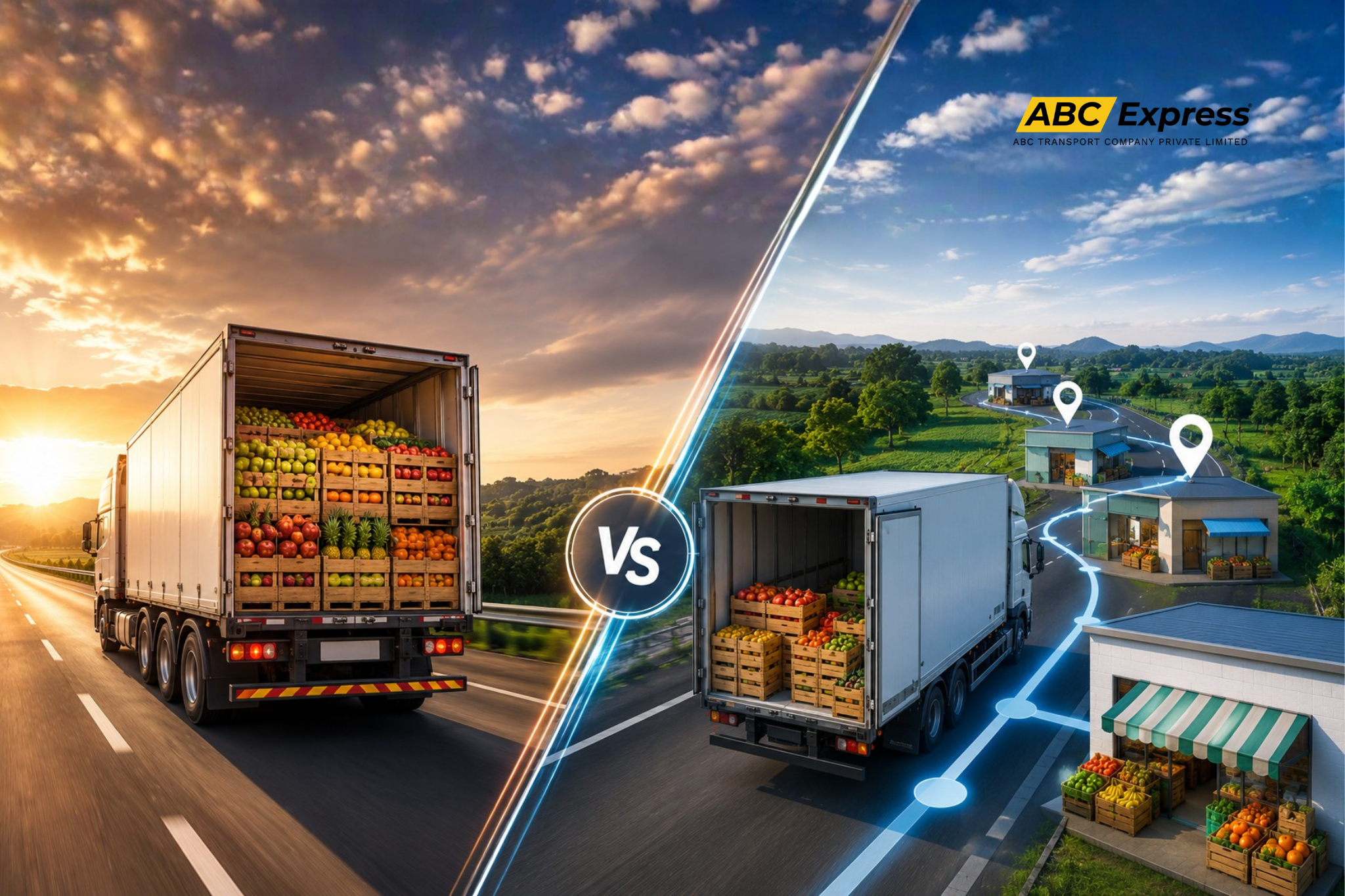
You’ve got goods to move. A deadline to meet. And a budget that can’t take a hit. The one question you need answered before booking your next shipment is this — do you need a full truck, or can your consignment share space with others?
This is exactly what FTL vs PTL services comes down to. And if you’ve been guessing your way through this decision, you’re probably leaving money on the table — or worse, paying for a truck you didn’t need. Understanding the difference between full truck load vs part truck load is one of those basics that quietly determines how efficient (or expensive) your logistics actually are.
What Is Full Truck Load (FTL)?
Full Truck Load, or FTL, is straightforward. Your shipment occupies the entire truck. No other consignments share the space. The truck goes from your pickup point directly to the delivery destination.
That’s it. No intermediate stops, no shared handling, no waiting for other shipments to load or unload.
FTL is typically the right call when you’re moving large volumes — bulk raw materials, industrial goods, high-value cargo, or anything that simply fills a truck on its own. Since the vehicle doesn’t stop elsewhere, transit time is shorter and the risk of damage is lower. Your goods are handled once — loaded at origin, unloaded at destination.
At ABC Express, FTL is built for businesses that need complete control — over schedules, over handling, over delivery timelines. One truck, one shipment, one clear responsibility.
What Is Part Truck Load (PTL)?
Part Truck Load, or PTL, works differently. Your shipment shares the truck with consignments from other businesses. You pay only for the space your cargo actually uses.
Think of it like a shared cab — everyone’s going in roughly the same direction, you split the cost, and it works out cheaper for all parties. The logistics company handles the job of combining compatible shipments based on routes, destinations, and schedules.
PTL makes a lot of sense for smaller businesses or for shipments that don’t justify an entire vehicle. Instead of booking a truck and sending it half-empty, you pay a fair share of the total capacity and still get your goods delivered professionally.
ABC Express runs PTL under its Parchoon service — a practical option for businesses that want reliable logistics without the cost of a dedicated truck.
FTL vs PTL Services: Key Differences
Here’s a plain breakdown of how FTL vs PTL services actually differ:
| Factor | FTL | PTL |
| Truck space | Full truck, exclusive | Shared with other shipments |
| Cost | Higher, fixed per truck | Lower, pay per space used |
| Transit time | Faster, direct route | Slightly longer due to multiple stops |
| Handling | Minimal — loaded once | More touchpoints |
| Best for | Bulk or high-value cargo | Smaller or frequent shipments |
| Control | Maximum | Standard |
Neither option is universally better. It depends on what you’re shipping, how much, and what you’re willing to spend.
When Should You Choose FTL?
Go with FTL when:
- Your shipment fills most or all of a truck anyway
- You’re moving fragile, high-value, or hazardous goods that need minimal handling
- Delivery speed is non-negotiable — you can’t afford extra stops
- You want complete accountability over a single consignment
- The nature of your cargo requires temperature control or special loading conditions
In full truck load vs part truck load decisions, FTL wins whenever the cargo itself demands it, not just when volumes are large. If protecting the integrity of your goods matters more than cost per kilogram, FTL is the safer bet.
When Should You Choose PTL?
PTL works well when:
- Your shipment is too small to fill a truck on its own
- You ship regularly in moderate quantities across fixed routes
- Cost efficiency is the priority and delivery timelines have some flexibility
- You want professional logistics handling without investing in a dedicated vehicle
- You’re a growing business that can’t yet justify FTL frequency
For many small and mid-sized businesses, FTL vs PTL services isn’t really a competition — PTL is simply the practical choice. You get proper logistics management, tracking, and delivery without paying for empty truck space.
Which Is Better: FTL or PTL for Your Business?
There’s no universal answer to which is better — FTL or PTL for business. The honest answer is that both serve a purpose, and the smartest businesses use both at different times.
If you’re shipping large volumes to a single location on a tight deadline, FTL is almost always worth the cost. If you’re moving smaller loads across multiple routes on a regular basis, PTL gets the job done at a fraction of the price.
The real question isn’t which is better in theory. It’s which one makes sense for your next shipment, your current budget, and your customer’s delivery expectations.
When you’re unsure, talking to a logistics partner who handles both — and can give you a straight recommendation — saves a lot of back and forth.
Conclusion
FTL vs PTL services is one of the most practical decisions in freight logistics, and it directly affects your costs, delivery speed, and cargo safety. Full truck load vs part truck load isn’t a complex call once you understand what each option actually delivers.
For bulk, time-sensitive, or high-value shipments — FTL. For smaller, cost-sensitive, or frequent shipments — PTL. And if you need someone who can help you figure out which is better, FTL or PTL for your business, without a sales pitch attached to it, ABC Express has been doing exactly that since 1958.
Reach out to the team at ABC Express, explore their FTL and Parchoon PTL services, and get your next shipment moving — the right way.