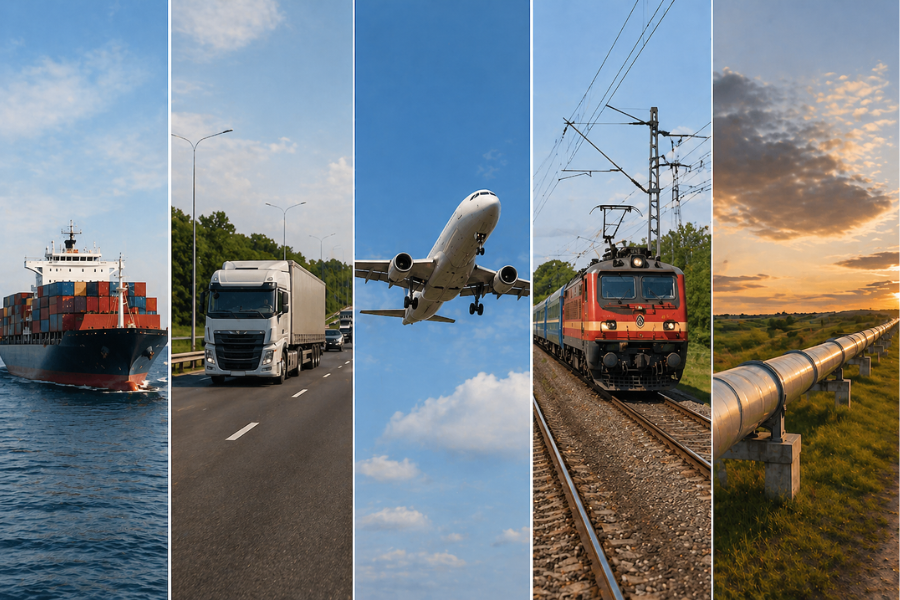
Every logistics decision starts with the same question: how is this getting there? The answer depends on modes of transport — the different methods used to move goods or people from one place to another. Road, rail, air, water, and pipeline. Each works differently, costs differently, and suits different types of cargo.
India’s freight industry moves billions of tonnes of goods every year. Most of it involves choosing between two or three transport options for the same route. Make the right call and you save time and money. Get it wrong and you pay for delays, damage, or a method the shipment did not need.
This guide explains all five modes, compares them side by side, and covers how to choose correctly — whether you are a business owner, procurement manager, or logistics coordinator.
What Is Modes of Transport?
When people ask how to define mode of transportation, the simplest answer is this: it is the specific infrastructure and vehicles used to move people or goods. Road uses highways and vehicles. Rail uses tracks and trains. Air uses airports and aircraft. Water uses ports, rivers, and ships. Pipeline uses fixed networks for liquids and gases.
The different modes of transport are not interchangeable. Each has a cost structure, a speed range, a cargo capacity, and a geographical reach. Understanding these differences is what separates good logistics planning from expensive guesswork.
In India, the modes of transport available have expanded over the last decade. Dedicated freight corridors have improved rail capacity. New expressways have cut road transit times. Inland waterways are growing. Air cargo infrastructure has spread to more cities. Each of these shifts the cost-benefit calculation for different shipments — which is why it pays to reassess your default mode regularly rather than assuming what worked last year still works best today.
Modes of Transport Chart
Here is a quick modes of transport chart covering the five primary methods:
| Mode | Best For | Speed | Cost | Reach |
| Road | Short-medium hauls, last-mile delivery | Medium | Medium | Very High |
| Rail | Bulk, heavy freight over long distances | Medium-Slow | Low | Medium |
| Air | Urgent, high-value, time-critical cargo | Very Fast | Very High | Medium |
| Water | International shipping, bulk coastal cargo | Slow | Lowest | Low (port-dependent) |
| Pipeline | Liquid and gas — oil, water, fuel | Continuous | Low (at scale) | Fixed |
This modes of transport chart is a starting point, not a final answer. Real decisions involve more nuance — cargo type, volume, packaging requirements, delivery deadlines, and budget all shift which option makes the most sense.
Five Modes of Transportation
Road Transport
Road is the most widely used mode in India and the most flexible of the 5 modes of transportation. Trucks, tempos, containers, and smaller commercial vehicles can reach destinations that no other mode can — tier-3 cities, industrial estates off major highways, rural areas, and urban delivery points.
The road network in India covers over 63 lakh kilometres. For most domestic freight — especially anything under 500 km or requiring door-to-door delivery — road is the default choice and often the right one.
Strengths: High geographical reach, flexible scheduling, door-to-door delivery, wide range of vehicle sizes. Limitations: Traffic delays on major corridors, higher cost than rail for very long distances, weather-dependent on certain routes.
Rail Transport
Indian Railways operates one of the largest freight rail networks in the world. For heavy, bulk cargo moving over long distances — coal, steel, cement, fertilisers, grain — rail is significantly cheaper per tonne-kilometre than road.
Transit time for shipping of industrial freight in DFC networks, which has been put to operation now on the Eastern Route as well as on the Western route, has been reduced by about 30%-40% between the major nodes. For large scale shippers, it makes quite a bit of difference in the figures.
Advantages: Low rates for bulk cargo; High capacity; More punctual services; Lower carbon footprint than the roads.
Disadvantages: No last mile deliveries; Set routes; Requires trucking from end to end.
Air Cargo
Of the 5 types of transportation systems, air cargo transport has the least time but the highest cost. Air freight is used when goods have high value or when time is critical.
High-value products like Pharmaceuticals, electronics, fresh products, precious jewelry, and medical equipment fall under air cargo category. In such cases, the high speed and reliability justify the cost involved.
In India, main air freight centers include Delhi, Mumbai, Bangalore, Hyderabad, and Chennai. A lot of cargo carried through air cargo is through belly freight on passenger planes.
Advantages: Fastest transit times; Punctual schedule; Lesser chance of loss and pilferage; Worldwide reach.
Disadvantages: Highest cost; Size and weight limitations; Unsuited for bulk cargo.
Water Transport
Water transport is the oldest mode of freight movement and still handles the largest share of global trade by volume. Over 95% of India’s international trade moves through ports. For domestic freight, coastal shipping between major ports offers a cost-effective alternative to road for large volumes moving between port cities.
Inland waterways — particularly National Waterways 1 (Ganga) and NW-2 (Brahmaputra) — are being developed under the Sagarmala programme. Still limited in reach, but growing.
Strengths: Lowest cost per tonne for large shipments, massive cargo capacity, suits heavy and non-perishable goods. Limitations: Slowest mode, only accessible near ports or navigable waterways, not suitable for urgent or perishable freight.
Pipeline Transport
Pipeline is a specialised mode used for liquids and gases — crude oil, natural gas, refined petroleum products, water, and slurry. It is not relevant for most general cargo but is the most efficient and cost-effective method for the materials it handles.
India has an extensive oil and gas pipeline network managed by operators like ONGC, BPCL, and GAIL. No loading, no unloading, continuous flow — for the right cargo, nothing else comes close.
Strengths: Continuous flow, low operating cost at scale, low manpower requirement, minimal handling losses. Limitations: Fixed routes, high initial infrastructure cost, only works for specific cargo types.
How to Choose the Right Mode of Transport?
Choosing between the different modes of transport comes down to five questions:
What are you shipping? Bulk commodities suit rail or water. Perishables need air or fast road. Hazardous goods have specific regulatory requirements for each mode.
Where is it going? Road reaches almost everywhere. Rail and water require specific infrastructure at both ends. Air needs airports. Match the mode to the destination, not just the origin.
When does it need to arrive? Urgent shipments may have no choice but air or fast road. Flexible timelines open up cheaper options.
What is the volume? High-volume, long-distance freight almost always has a cheaper mode than road. Low volumes and short distances usually do not.
What is the budget? Modes range from lowest (water) to highest (air) in cost. The best mode is the one that meets the delivery requirement at the lowest justifiable cost — not necessarily the cheapest, not the fastest.
Advantages of Using the Right Transport Mode
Matching cargo to the right mode produces measurable benefits:
Lower freight cost. Moving bulk goods by rail instead of road reduces cost by 30–50% on long routes. Water freight for coastal shipments saves even more.
Fewer delays. Rail and water follow predictable schedules. Air is almost always on time. Road is flexible but most vulnerable to disruption.
Less cargo damage. Fewer handling points mean less damage risk. Air freight has significantly fewer transfers than multimodal ground shipments.
Better compliance. Pharmaceuticals, chemicals, and food have mode-specific rules. The wrong mode creates compliance issues that cost more than the freight.
Lower carbon footprint. Rail and water produce far fewer emissions per tonne-kilometre than road or air — important for businesses with ESG targets.
Why Road Transport Is Most Popular?
Among all the modes of transport, road remains the most widely used in India — and it is not hard to see why.
No other mode offers the same combination of reach, flexibility, and last-mile capability. Rail needs trucks at both ends. Water needs a port. Air needs an airport. Road needs a vehicle and a driveable route — which in India covers almost every delivery point that matters commercially.
For time-sensitive domestic freight, regional distribution, and door-to-door delivery, road is the default. It scales from a small parcel in a tempo to a 40-foot container on a national highway.
ABC Express operates a dedicated road freight network across India — GPS-tracked vehicles, consistent transit times, competitive pricing, and coverage across major industrial and commercial corridors. For businesses that need reliable ground movement, they are worth a conversation before the next dispatch.
Conclusion
If you had to define mode of transportation in one line — it is the method you choose to move cargo from A to B. Simple concept, significant consequences depending on how you apply it.
The modes of transport available in India today — road, rail, air, water, and pipeline — cover every freight requirement. Each works differently, costs differently, and suits different cargo, distances, and timelines.
The mistake most businesses make is defaulting to one mode out of habit. Road is not always right. Rail is not always slow. Air is not always out of budget. Getting this decision right — even occasionally — compounds into real savings over a year.
For road freight across India, ABC Express provides reliable coverage, consistent service, and rates that make sense for regular shippers.